4-7-8 Breathing: How to Do the Technique
Learn the 4-7-8 breathing pattern step by step: exact counts, a beginner version, how long to practise, what to expect and when to stop.
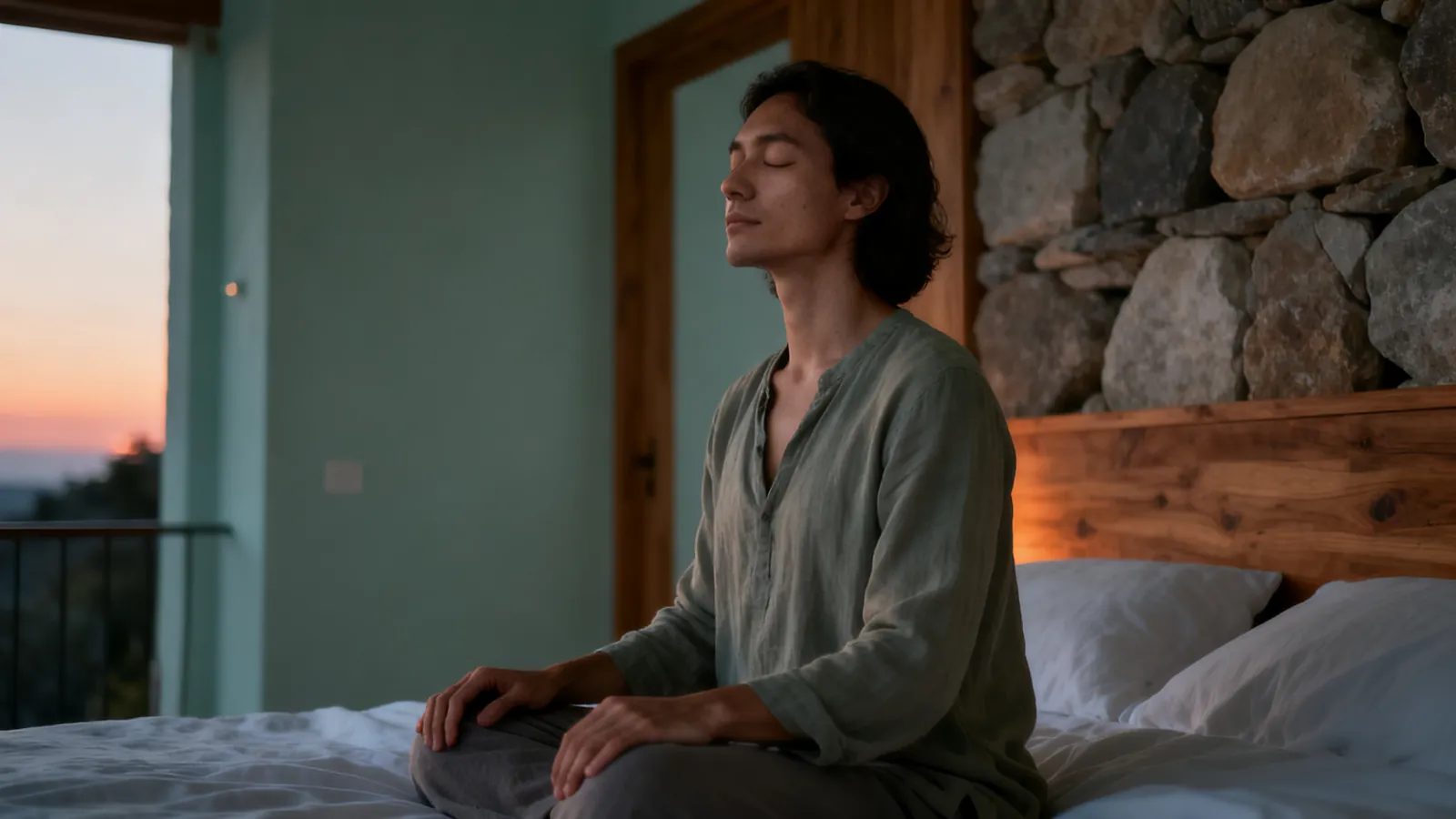
The 4-7-8 pattern is a breathing exercise built around a long, slow exhale. The three numbers are counts: breathe in for four, hold for seven, breathe out for eight. It is often used at bedtime, or in any moment when the body feels switched on and the mind will not settle. The counts are a guide, not a test. The part that tends to matter most is the exhale being noticeably longer than the inhale.
What the three numbers mean
Each number is a count in seconds, kept roughly steady in your head or by watching a clock.
- 4 — breathe in through the nose for four counts.
- 7 — hold the breath gently for seven counts.
- 8 — breathe out through the mouth for eight counts.
One round is one full cycle. Most people start with four rounds and build up slowly over weeks rather than days.
Why the long exhale matters more than the exact counts
Breathing out slowly and steadily is the part of the pattern that most people notice. A long exhale tends to be linked with the body easing down a gear: heart rate can settle, shoulders can drop, and the urge to take another quick breath fades. The inhale and the hold set up that long exhale, but they are not the point of it.
This is why the exact numbers can be adjusted. If seven seconds of holding feels like too much, a shorter hold still works. If eight seconds of exhaling is a stretch, six is fine. What matters is the shape of the breath: in, pause, then a slow out-breath that lasts longer than the in-breath.
How to do 4-7-8 breathing
Sit upright or lie down. A chair with back support or a bed with the head slightly raised both work. Rest one hand on the belly if it helps you feel the breath move.
- Settle first. Let the breath return to normal for a few cycles. Do not launch straight into the counts.
- Breathe in through the nose for four counts. Keep it quiet and easy. The belly should rise more than the chest.
- Hold for seven counts. Keep the throat relaxed. Do not clamp the breath or brace the belly.
- Breathe out through the mouth for eight counts. Lips slightly parted, a soft whoosh or a silent stream of air. Let the out-breath taper off rather than stopping it abruptly.
- Repeat for four rounds. That is the usual starting dose. Four rounds take roughly a minute and a half.
After four rounds, return to normal breathing and notice what has changed. Some people feel a little heavier in the limbs, or a drop in the urge to keep going over the day’s list. Others feel very little the first time, which is common.
A beginner version with smaller counts
The full 4-7-8 is not the only way in. If seven seconds of holding feels uncomfortable, scale the whole pattern down and keep the proportions roughly the same.
- Beginner: in for 2, hold for 3, out for 4.
- Building: in for 3, hold for 5, out for 6.
- Standard: in for 4, hold for 7, out for 8.
Stay at one level for a week or two before moving up. The aim is a breath that stays smooth at every count. If the last second of the hold feels like a strain, the counts are too long for now.
How long and how often
Four rounds, once or twice a day, is a reasonable starting point. Many people use it in bed as the last thing before sleep, and some add a second round in the late afternoon when the day’s tension tends to build.
A short practice done most days is generally easier to keep up than a long one done occasionally. If four rounds feel easy and pleasant, six or eight rounds are fine. If four rounds feel like a chore, do two.
What it feels like the first time
The first attempt is often clumsy. Counting in your head while breathing is a juggling act, and the hold can feel longer than seven seconds really is. Common experiences include:
- A slightly dry mouth from breathing out through parted lips.
- A urge to breathe in early during the hold.
- A wave of heaviness or drowsiness after the third or fourth round.
- Very little sensation at all, especially if the day has been busy.
None of these mean the technique is being done wrong. The body usually adapts over a week or two of regular practice, and the counting becomes automatic.
Why it is often used at bedtime
A long, slow exhale fits naturally into the wind-down before sleep. Lying still, breathing out slowly and counting gives the mind a simple task to hold onto, which can crowd out the mental replay of the day. Many people find that pairing it with lights down and a screen put away makes the whole routine easier to settle into.
It is not a switch. Some nights it helps within a few rounds; other nights the mind stays busy and sleep takes its usual time. Used regularly, it tends to become a familiar cue that the day is over.
When to stop: the dizziness rule
Stop the exercise and breathe normally if it brings on dizziness, lightheadedness, tingling in the hands or face, or a feeling of pressure in the head. These are signs that the breathing has become too slow or too deep for the moment. Sit up, let the breath return to its natural rhythm, and wait until the feeling passes before deciding whether to try again with smaller counts.
People who are pregnant, or who have a heart or lung condition, should check long breath holds with their clinician before starting. The holds can be shortened or left out entirely; the long exhale on its own is still worth practising.
What people get wrong
A few habits make the technique harder than it needs to be.
- Chasing the exact counts. Seven seconds is a guide. If the hold is a strain, the pattern has stopped being relaxing.
- Breathing from the chest. A shallow, high breath makes the hold feel tight. Let the belly move instead.
- Forcing the exhale. Pushing the air out hard is not the same as breathing out slowly. Keep it quiet and even.
- Doing too many rounds too soon. Ten rounds on the first night often ends in frustration. Four is enough to start.
- Using it only in a crisis. A pattern practised on calm days is easier to reach for on a hard one.
When it does not help
Some nights the breath will not settle, and that is not a failure of effort. If the mind is racing because of a real problem that needs attention, no breathing pattern will solve it. If the technique makes you more anxious, more aware of your heartbeat, or more short of breath, stop and return to normal breathing.
If stress, low mood, panic or poor sleep is persistent, or is affecting daily life, speak to a doctor or a mental health professional. If there is urgent distress or any thought of self-harm, contact local emergency services right away.
How it compares with other patterns
| Pattern | Shape of the breath | Often used for | When it does not fit |
|---|---|---|---|
| 4-7-8 | In 4, hold 7, out 8 | Settling before sleep, quieting a busy mind | Anyone who finds breath holds uncomfortable, or who feels dizzy with slow breathing |
| Box breathing | In 4, hold 4, out 4, hold 4 | Steadying focus before a task or a difficult conversation | People who dislike pauses at the top of the breath |
| Longer exhale, no hold | In 4, out 6 to 8 | A first step into slow breathing, or daytime tension | Anyone looking for a strong, structured count |
| Physiological sigh | Two short inhales through the nose, one long exhale | A quick reset in the middle of the day | Bedtime, where a slower, longer pattern tends to suit better |
The 4-7-8 pattern sits at the slower, more structured end of the range. It suits a quiet room and a few unhurried minutes. For a busy afternoon, a shorter pattern with no hold is often easier to fit in.
Common questions
Can 4-7-8 breathing be done lying down?
Yes. Lying on the back with the head slightly raised is one of the most common positions, and it is the one many people use in bed. Sitting upright in a chair works just as well if lying down makes you feel too drowsy to keep track of the counts.
How many rounds should a beginner do?
Four rounds is a sensible starting point, once or twice a day. That is roughly a minute and a half of practice. Add a round or two every week or so if the pattern feels comfortable, rather than jumping straight to a long session.
Is it safe to hold the breath for seven seconds?
For most healthy adults, a seven-second hold within a slow breathing pattern is well tolerated. Anyone who is pregnant, or who has a heart or lung condition, should check long breath holds with their clinician first. Stop and breathe normally if dizziness or lightheadedness appears.
Why does 4-7-8 breathing make me dizzy?
Dizziness usually means the breathing has become too slow or too deep for the moment, which changes the balance of gases in the blood. Stop the exercise, breathe normally and let the feeling pass. If it returns, shorten the counts or drop the hold and keep only the long exhale.
Does it have to be exactly 4-7-8?
No. The proportions matter more than the exact seconds. A pattern of 2-3-4 for beginners, or 3-5-6 while building up, follows the same shape: a short inhale, a gentle hold, and an exhale that lasts longer than the inhale.
Can it be used during the day?
Yes. It is often used at bedtime, but a few rounds in the late afternoon or before a demanding task can work just as well. Some people find the holds too heavy for daytime use and prefer a simple longer exhale instead.
Common questions
Can 4-7-8 breathing be done lying down?
Yes. Lying on the back with the head slightly raised is one of the most common positions, and it is the one many people use in bed. Sitting upright in a chair works just as well if lying down makes you feel too drowsy to keep track of the counts.
How many rounds should a beginner do?
Four rounds is a sensible starting point, once or twice a day. That is roughly a minute and a half of practice. Add a round or two every week or so if the pattern feels comfortable, rather than jumping straight to a long session.
Is it safe to hold the breath for seven seconds?
For most healthy adults, a seven-second hold within a slow breathing pattern is well tolerated. Anyone who is pregnant, or who has a heart or lung condition, should check long breath holds with their clinician first. Stop and breathe normally if dizziness or lightheadedness appears.
Why does 4-7-8 breathing make me dizzy?
Dizziness usually means the breathing has become too slow or too deep for the moment, which changes the balance of gases in the blood. Stop the exercise, breathe normally and let the feeling pass. If it returns, shorten the counts or drop the hold and keep only the long exhale.
Does it have to be exactly 4-7-8?
No. The proportions matter more than the exact seconds. A pattern of 2-3-4 for beginners, or 3-5-6 while building up, follows the same shape: a short inhale, a gentle hold, and an exhale that lasts longer than the inhale.
Read next

Box Breathing: How to Do the Four-Equal-Sides Method
Learn box breathing: inhale, hold, exhale, hold, each for four counts. Step-by-step guide, beginner adjustments, and when to use it.
Diaphragmatic Breathing: A Step-by-Step Guide
Learn diaphragmatic breathing with step-by-step instructions. Discover how to tell chest from belly breathing, a lying-down practice, and a seated version.

Breathing Exercises for Stress: A Practical Guide
Learn five breathing exercises for stress: slow exhale, box breathing, 4-7-8, belly breathing, and the physiological sigh, with counts, timings, and safety notes.